Does the cemetery require a vault? What to check before you pay for one
The Seventh Work- Subject
- choosing and paying for caskets, outer burial containers and the other funeral goods sold alongside them
- Editor
- The The Seventh Work team
- Subject
- choosing and paying for caskets, outer burial containers and the other funeral goods sold alongside them
The Seventh Work
Most families discover the second container late, usually after the casket has been chosen and the funeral home mentions, almost in passing, that the cemetery will need something underneath it. That item is the outer burial container, and depending on which model is sold it can add a few hundred dollars or several thousand to a bill that already felt settled. The distinction between the cheap version and the expensive one is real, but it is narrower than the showroom language suggests, and the rule creating the requirement usually comes from a party who is not standing in the room.
1. A liner and a vault are built for different jobs
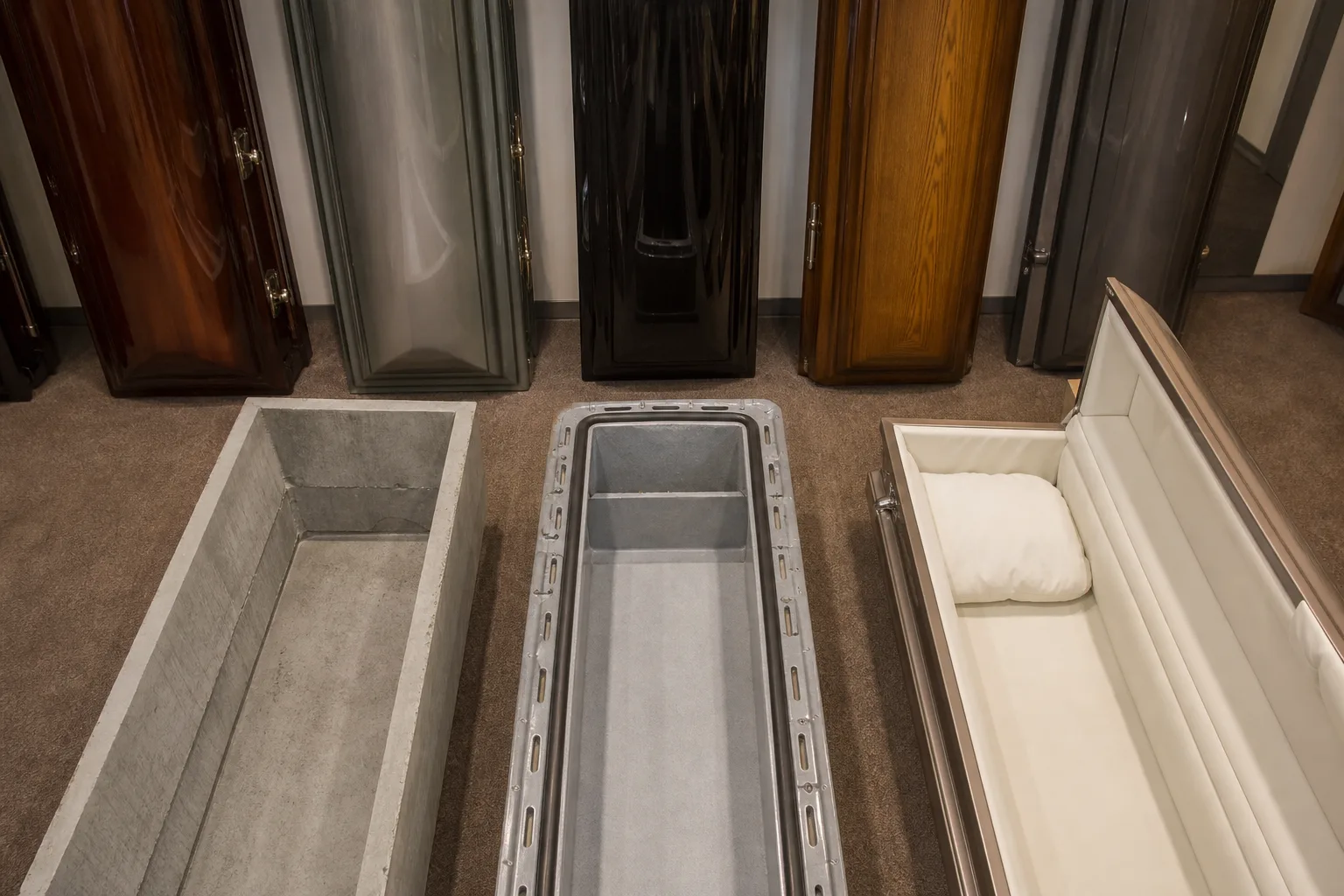
A grave liner is a plain concrete box, sometimes a set of concrete sections assembled in the grave, whose only purpose is to carry the weight of soil and cemetery equipment so the ground does not sink as the casket gives way. A burial vault does that same structural work and adds a lined and sealed interior, typically a plastic or metal inner shell, joined with a sealant at the lid. The structural function is identical. What separates the two on the price list is the sealing, the exterior finish, and the warranty language attached to both.
2. The cemetery sets the requirement, and it puts it in writing
State law rarely requires an outer container at all; cemeteries require them, because settled ground is expensive to maintain and dangerous to mow. That means the operative document is the cemetery's own rules and regulations, which any office will hand over on request, and which will normally specify a minimum standard rather than a particular brand. Some cemeteries accept a basic liner throughout. Some require a full vault in certain sections and not others. A careful reader asks for that section of the rulebook before agreeing to anything, because it converts a sales conversation into a specification.
3. The price list arrives before the sample
Under the Funeral Rule, which the Federal Trade Commission oversees, a funeral provider that sells outer burial containers has to give you a printed list of them, with prices, before showing you the merchandise, and the general price list has to disclose that state law generally does not require a vault. Read the disclosure. Then read what is bundled: some containers are quoted with graveside setup and equipment included, others are not, and the cemetery may charge separately for installation on the day. Two quotes are only comparable once you know which fees each one already contains.
4. Sealing is a feature, not a legal category
Sealed containers exist and they are sold honestly enough as sealed, but no federal or state rule requires sealing, and no seller may claim that any container preserves a body indefinitely. The warranty usually covers the container itself against certain kinds of failure, not the contents, and it is worth reading the actual certificate rather than the brochure. If sealing matters to a family for reasons of its own, that is a fair reason to buy it. If it is being offered as protection, the honest question is protection of what, and the paperwork will answer plainly.
5. Cremation needs far less, and the rules say so
Direct cremation requires a rigid, combustible container, not a casket, and a provider offering direct cremation has to make an unfinished wood box or an alternative container of cardboard or composition material available. Nobody may require you to buy a casket for it. An urn is not required either, and a provider cannot refuse to handle one bought elsewhere or charge a fee for accepting it. Where cremated remains are buried in a plot rather than kept or scattered, the cemetery may ask for a small urn vault, and that requirement, again, lives in the cemetery's rules.
6. What the careful buyer checks first
Call the cemetery before the arrangement conference, ask for the minimum acceptable container in that specific section, and ask what the cemetery itself charges to install it, since that fee is theirs and not the funeral home's. Compare the funeral home's outer container list against a local monument dealer or an online supplier, which the Funeral Rule also permits you to use. Confirm what a liner costs in the same place a vault costs. The gap between them, stated in dollars, is the decision you are actually making.
Two documents settle nearly all of this: the cemetery's written rules and the provider's printed container list. Ask for both early, side by side, and the second container stops being a surprise and becomes a line you chose.
| Plain concrete liner | A grave liner is an unlined concrete box or a set of concrete panels assembled in the grave. Its job is to hold the earth up so the ground surface stays level over time. |
| Lined and sealed vault | A burial vault does the same structural work as a liner but adds an inner shell of plastic, fiberglass or metal and a sealed lid. The extra cost is in that lining, the exterior finish and the warranty. |
| Who imposes the rule | Almost no state requires an outer burial container. Individual cemeteries require them to keep graves from settling, which makes the cemetery office the place to ask. |