Poplar or mahogany, 18 gauge or 20 gauge? What to check before you sign
The Seventh Work- Subject
- choosing and paying for caskets, outer burial containers and the other funeral goods sold alongside them
- Editor
- The The Seventh Work team
- Subject
- choosing and paying for caskets, outer burial containers and the other funeral goods sold alongside them
The Seventh Work
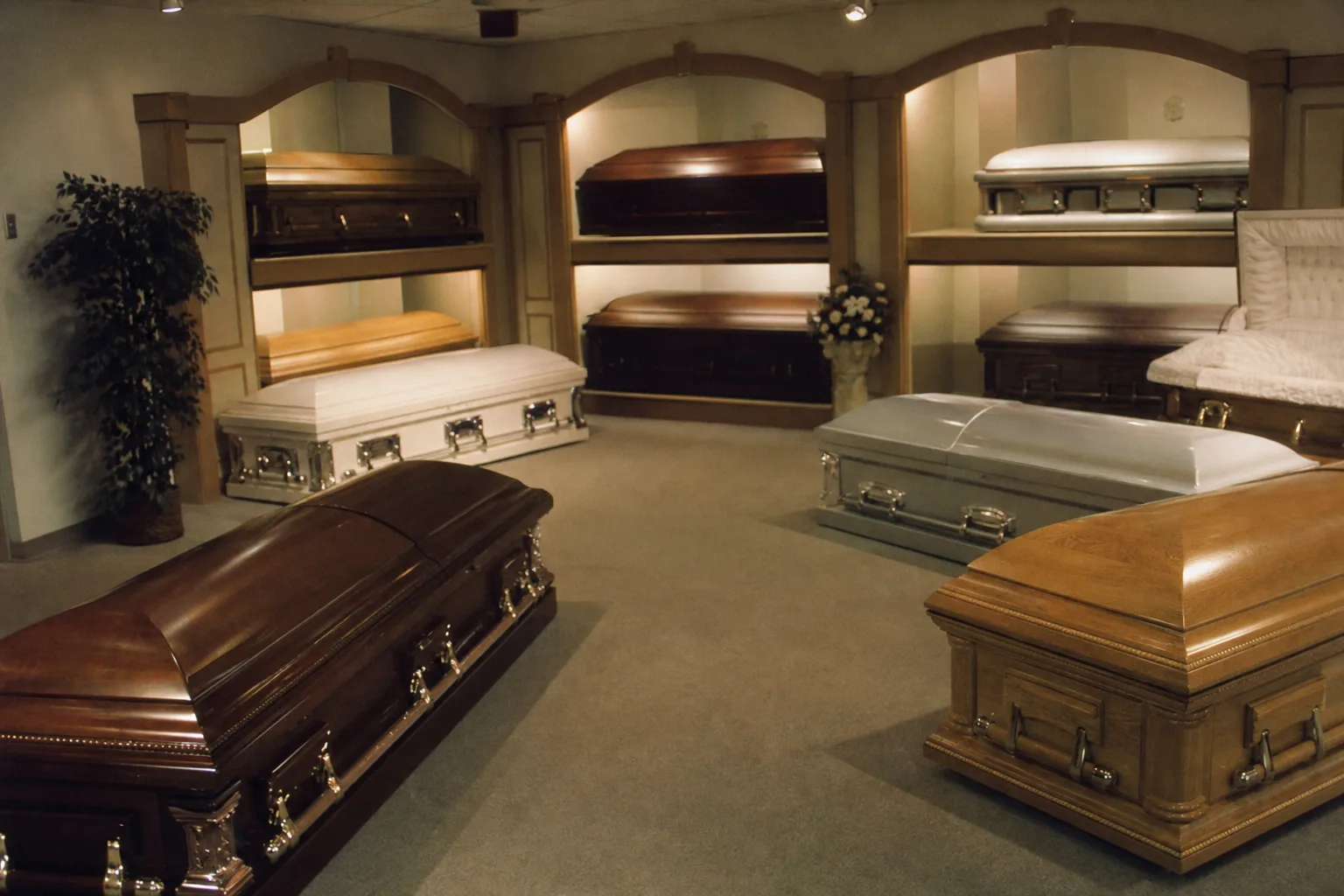
A casket showroom rewards a reader who slows down, because almost everything that separates a two thousand dollar casket from a six thousand dollar one is written somewhere on the card beside it, in a shorthand nobody explains out loud. Species, gauge, finish, interior fabric, whether the lid closes against a gasket. Those five items account for most of the spread in price. None of them is difficult once you know what the words are pointing at, and a careful reader can work through the whole room in twenty minutes with no help at all.
Wood: the species does the work, the finish hides it
Poplar and mahogany are both sold as hardwood, and the word is doing very little to distinguish them. Poplar is a light, soft, inexpensive domestic wood that takes stain evenly and is often finished to resemble something costlier; pine and oak sit nearby at modest prices, with oak showing an open, coarse grain that many people like on sight. Mahogany, walnut and cherry cost more because the lumber costs more and because the grain is worth showing rather than covering. The check is simple: read the card for a named species, and treat the word hardwood alone as telling you nothing.
Look at the corners and the lid edges. On a better wood casket the panels are thicker, the joinery is visible and deliberate, and the finish is rubbed rather than sprayed heavy enough to fill the pores. A stained poplar box under a high-gloss coat can photograph identically to walnut and will serve identically at a service, which is a real argument for buying it on purpose rather than by accident. What you should not do is pay walnut money for a card that declines to say what tree it came from.
Gauge is a thickness measurement that runs backwards
Steel caskets are priced largely on gauge, and the number counts down as the metal gets thicker: 20 gauge is thinner than 18, and 18 is thinner than 16. Most of the steel caskets in a typical selection room are 20 or 18 gauge, with 16 gauge appearing at the top of the line and stainless steel or copper and bronze sold as a separate tier above that. The practical difference between 20 and 18 is modest weight, modest rigidity, and a price step that is often several hundred dollars. Ask which gauge, and ask it about the specific casket in front of you.
Copper and bronze are sold by weight per square foot rather than gauge, typically thirty-two or forty-eight ounces, and they are priced accordingly because the metal does not corrode the way steel does. That is a genuine material difference and worth knowing. It is also the point at which the conversation usually turns from what the casket is made of to what the casket is claimed to do, and that turn deserves its own attention.
What the gasket does, and what it does not
A protective or sealing casket has a rubber gasket set into the rim and a locking mechanism that draws the lid down against it. That assembly resists the entry of air, water and outside elements, which is what the manufacturer's literature will say, and the phrasing is careful for a reason. The Federal Trade Commission oversees funeral goods and services sold to consumers and prohibits a seller from claiming that any casket or sealing device will preserve a body indefinitely. Decomposition is driven by processes that begin inside the body, and no gasket addresses those. A sealed casket keeps groundwater out for a period; it does not suspend biology.
So the question to hold in mind is what you are buying the seal for. Some families want it, understanding exactly this, because the idea of water intrusion troubles them and the added cost is acceptable. Others, once the claim is stated plainly, would rather put the same money into a better wood, a better vault, or nothing at all. Both answers are reasonable. The check is that nobody should sell you a gasket by implying something the rule does not permit them to say directly.
The four questions that settle it
Name the species or the gauge. Confirm whether the price includes the interior shown. Ask whether the model is sealing or non-sealing, and what the non-sealing version of the same shell costs. Then ask to see the casket price list, which sets out every model offered with its price, so you can compare the whole line rather than the three the showroom has arranged at eye level. Those four questions take a few minutes and routinely move a decision by more than a thousand dollars, in whichever direction the family actually wants it to move.
The specifications are not secrets. They are printed, standardized, and consistent from one manufacturer to the next, which means a family willing to read them is negotiating from the same information the person across the desk has.
| Poplar under stain | Poplar is inexpensive, light and takes stain evenly, which is why it is often finished to resemble more expensive woods. Bought knowingly it is good value; bought unknowingly it is an overpayment. |
| Gauge counts backwards | In sheet steel, a higher gauge number means thinner metal, so 20 gauge is thinner than 18 and 18 is thinner than 16. Most showroom steel caskets fall in the 20 to 18 range. |
| Copper and bronze are weighed | Non-ferrous caskets are specified by ounces per square foot rather than gauge, commonly thirty-two or forty-eight. They cost more because the metal does not rust. |